
The “final finish” of a product is rarely just about looks. It is a strategic decision that affects your bottom line, your production speed, and your reputation for quality. In the industrial world, the debate over powder coating vs liquid paint usually comes down to three main factors: how long it lasts, how much it costs, and its environmental impact.
At Precision Powder, we’ve spent over two decades helping Pacific Northwest (and beyond!) businesses navigate these choices. While both methods have their place, understanding the technical differences is key to making sure your next commercial project stands up to the pressures of the real world.
The Core Difference: Liquid vs. Dry
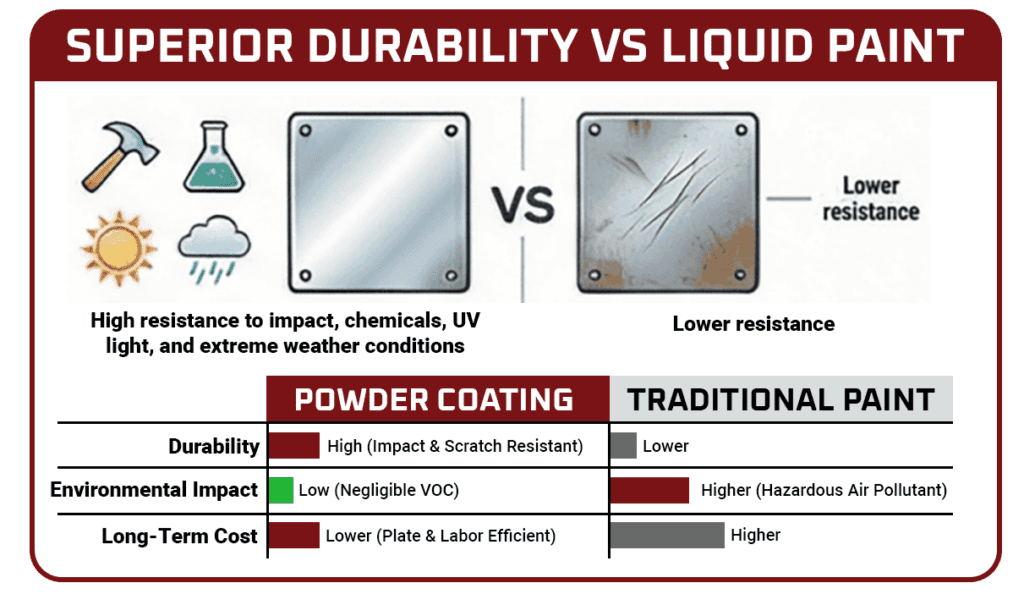 To understand the performance gap, you have to look at how these coatings are made. Traditional liquid paint is a mixture of pigments and resins held together by a “carrier”—usually a chemical solvent or water. For the paint to dry and form a solid film, the liquid carrier must evaporate into the air.
Powder coating, on the other hand, is a completely dry process. No liquids or solvents are involved. Instead, the coating is made from finely ground particles that provide color and protection. Because it starts as a solid, it behaves very differently once it is applied to your parts.
Why Powder Stays Tougher for Longer
The durability of powder coating comes from a permanent chemical bond created in our industrial ovens. This is known as “thermosetting.” As the powder-coated parts are baked, the particles melt and fuse together into a dense, interlocking network. Once this shield is formed, it is irreversible. It won’t soften if it gets hot again, and it provides a much tougher defense against scratches, chips, and chemicals than standard paint.
Liquid paint often results in a “softer” finish. Because it relies on evaporation to dry, the resulting film is thinner and more prone to peeling or cracking over time, especially when exposed to moisture or heavy use.
Furthermore, powder coating allows us to apply a much thicker layer in a single pass. While liquid paint can drip or “run” if you try to put it on too thick, powder stays perfectly uniform. This extra thickness is what gives industrial machinery, automotive parts, and structural steel the heavy-duty protection they need to survive all types of climates, including the most humid.
Efficiency and the Bottom Line
From a management perspective, efficiency is everything. This is where powder coating truly shines in a high-volume commercial setting.
-
Magnet-Like Application: We use “Electrostatic Spray Deposition” to apply the powder. We give the powder particles a positive charge and ground the metal part. The powder is literally pulled toward the part like a magnet, wrapping around edges and reaching into corners that are difficult to cover with liquid spray.
-
Zero-Waste Production: Liquid paint is notoriously wasteful. On average, 50% to 70% of the paint sprayed never actually hits the part—it ends up as “overspray” that has to be thrown away. In our modern powder booths, we can collect that overspray and reuse it. This leads to material utilization rates as high as 97%, which significantly lowers your material costs on large runs.
-
Faster Turnarounds: Liquid paint can take hours or even days to fully cure and harden. Powder coating is ready to be handled, packed, and shipped as soon as it cools down from the oven. At Precision Powder, we use this speed to offer turnaround times that are among the fastest in the industry.
Environmental Safety and Compliance
Compliance with environmental laws is no longer optional for manufacturers. Many regulatory agencies are increasingly cracking down on Volatile Organic Compounds (VOCs)—the toxic fumes emitted by liquid paint solvents.
Because powder coating is solvent-free, it releases virtually no VOCs into the air. This makes it safer for the planet and, more importantly, safer for the people working in the shop. By choosing powder, you avoid the administrative headaches and expensive air-scrubbing equipment required to manage hazardous paint fumes.
When is Liquid Paint the Right Choice?
While we are experts in powder, we also know its limits. Powder coating requires parts to be baked at roughly 400°F. If your project involves heat-sensitive materials like certain plastics, wood, or parts with rubber seals that can’t be removed, liquid paint is the safer bet. Liquid paint is also the only option for “on-site” work, such as touching up a bridge or a building after it has already been installed.
The Precision Powder Advantage
A coating is only as good as the surface underneath it. We differentiate ourselves through an obsessive focus on preparation. We house a massive 65-foot sandblast booth to clean and “prep” even the largest structural parts, ensuring the coating has a perfect surface to bond to. For raw metals, we use a 5-stage immersion system that cleans and pretreats each piece with a zirconium-based corrosion inhibitor.
Whether you are looking for “Class A” cosmetics for high-end consumer products or industrial-strength protection for heavy machinery, our process-based system is designed to deliver a finish that never cracks under pressure.
Ready to see the difference for yourself?
Don’t leave the longevity of your project to chance. Contact Precision Powder Coating today for a quote. Our project managers are ready to help you streamline your production and give your products the durable, high-quality finish they deserve.
Posted Under: Insights